RGB
3 Colours. 3 Galleries. 18+ Artists.
Dates: 12th – 23rd November
Private View: 12th November | 6:00 PM – 9:00 PM
Opening Hours: Weekdays: 10:00 AM – 5:00 PM & Saturdays (14th & 21st Nov): 12:00PM – 5:00PM
Location: The Handbag Factory
RGB - Red, Green, and Blue - forms the foundation of modern digital colour. Every pixel on our computer monitors and smartphone screens relies on these three primary hues to generate our visual digital world. But the history of RGB reaches far beyond modern screens into the origins of physics, human perception, and light.
18th-Century Optics: Physicist Thomas Young first suggested that the human eye possesses three distinct wavelength-dependent cells. While identifying these photoreceptors took over a century, scientists today know that our perception of colour is as much about learned behaviour and context as it is about the physical spectrum of light.
The First Colour Photo: In 1861, James Clerk Maxwell projected three separate single-colour slides (Red, Green, and Blue) of a single image together, creating what the human eye perceived as the world's very first colour photograph.
At The Handbag Factory, light within comes in three distinct flavours. Each room in this exhibition presents contemporary artwork that tells its own narrative, diving into cultural colour associations, Freudian connotations, politics, gender, and the raw materiality of pigment.
The Exhibitions & Curators
Red Room
Curated by: Katie Pratt & Raksha Patel
Featuring Artists: Cristallina Fischetti, Danying Chen, Hannah Knox, Alex Veness, Allyson Keehan,
Cathy Lomax, Howard Rogers, Katie Pratt, Laura White, Michael Ajerman, Raksha Patel, Richard O’Russa, Sohrab Crews, Clare Chapman, Umar Ahmed, Uzma Sultan, Rosemary Cronin, Yu Xiao, Ritu Sood,
Sarah Kate Wilson & Anish Kapoor.
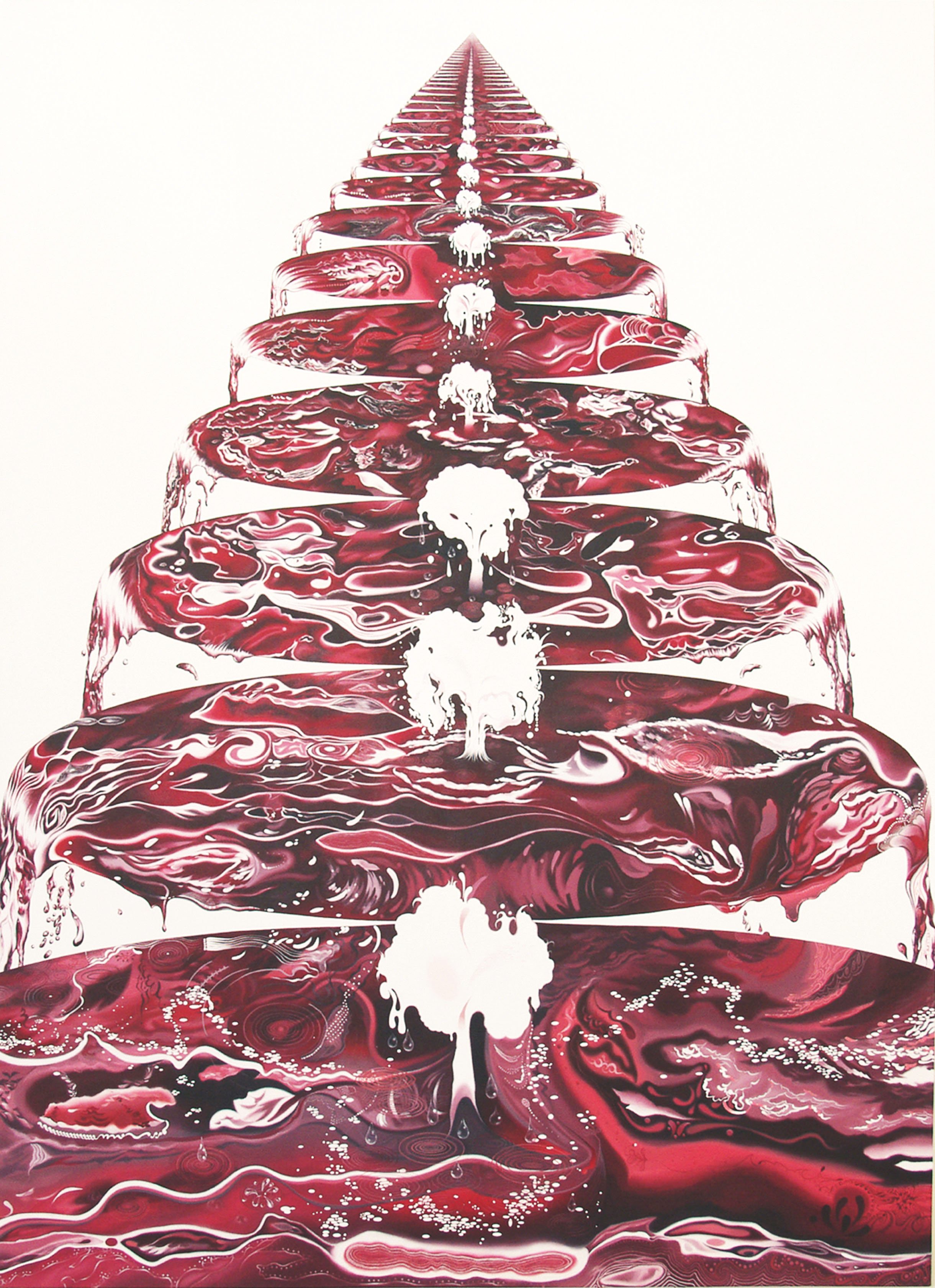
Raksha Patel, Untitled, Acrylic on canvas, 213 x 123cm, 2005, Courtesy and © of the artist
For RGB, we consider what Red means in different cultural contexts and the diverse ways that contemporary artists have utilised red: for both its abject impact in relating to human and animal bodies and its semiotic value across societal codes. As painters ourselves with disparate creative concerns, we sought a range of ideational content from works that possess a visceral quality through direct engagement with a range of materials that are exploited here for their innate physicality; paint, paper, ceramic, textile and performance.
The works exhibited investigate various interpretations and applications of red through form, representation and translation, reflecting the expansive ways artists use paint and pigment across media.
Green Room
Curated by: Scott McCracken & Pia Ortuño
Featuring Artists: Alice Wilson, Dan Hays, Diana Puntar, Dieter Durinck, Helen Clarke, Kes Richardson, Tom Palin, Oliver Hoffmeister, Pia Ortuño, Samuel Domínguez, Scott McCracken & Shaan Syed.
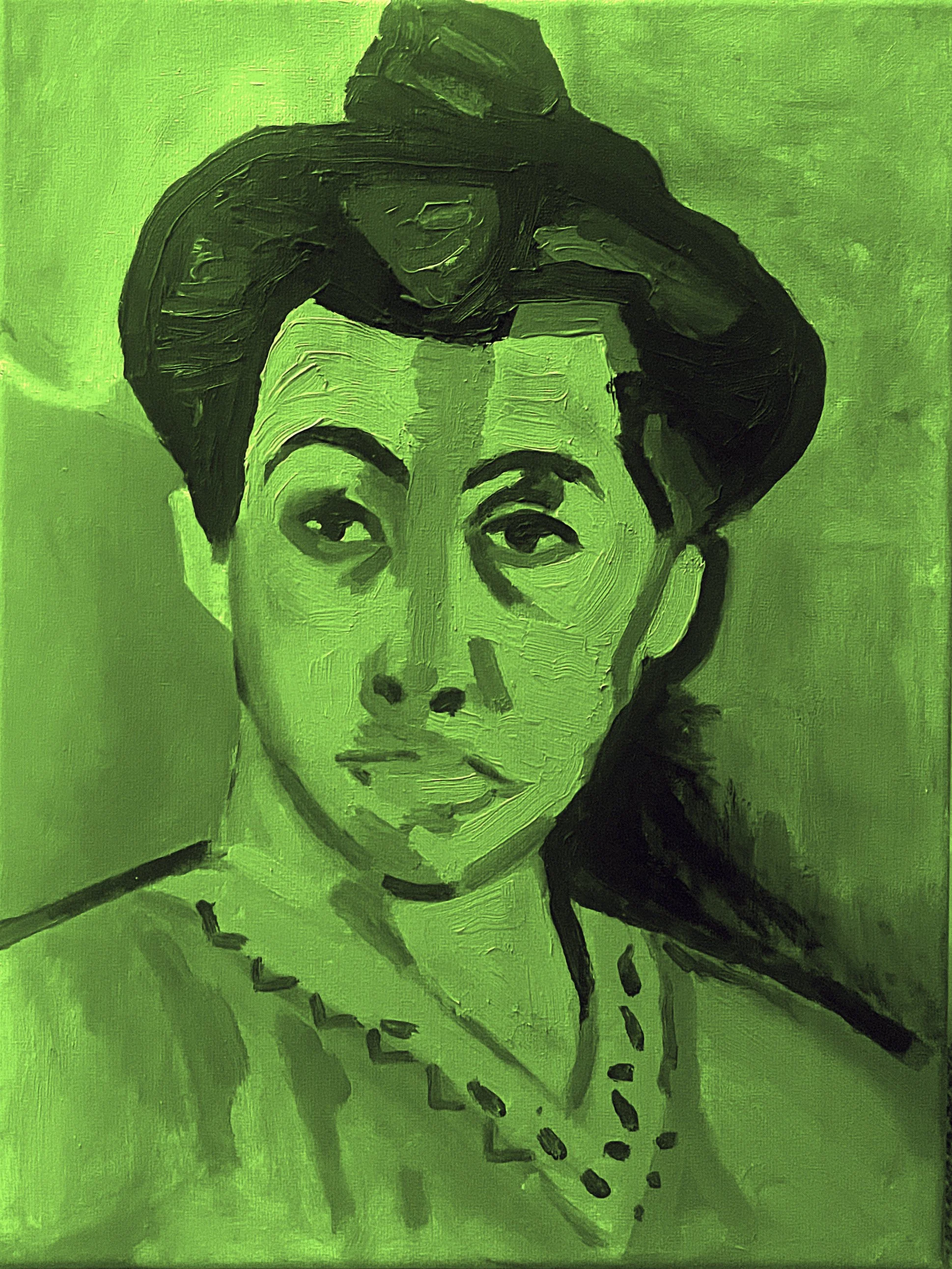
Dieter Durinck, Made to Order, Henri Matisse - The Green Stripe 1905, Oil on canvas, 40x30cm, 2023
“The tree which moves some to tears of joy is in the eyes of others only a green thing that stands in the way. Some see nature all ridicule and deformity…and some scarce see nature at all. But to the eyes of the man of imagination, nature is imagination itself” - William Blake
Blue Room
Curated by: Michael Coppelov & Magdalena Głuszak-Holeksa
Featuring Artists: Magdalena Głuszak-Holeksa, Michael Coppelov, Adam Hennessey, Kaler Q Huang, Alastair Gordon, Jude Wainwright, Ella Reid, Ana Milenkovic, Kristian Evju, Iain Andrews & Karolina Albricht.
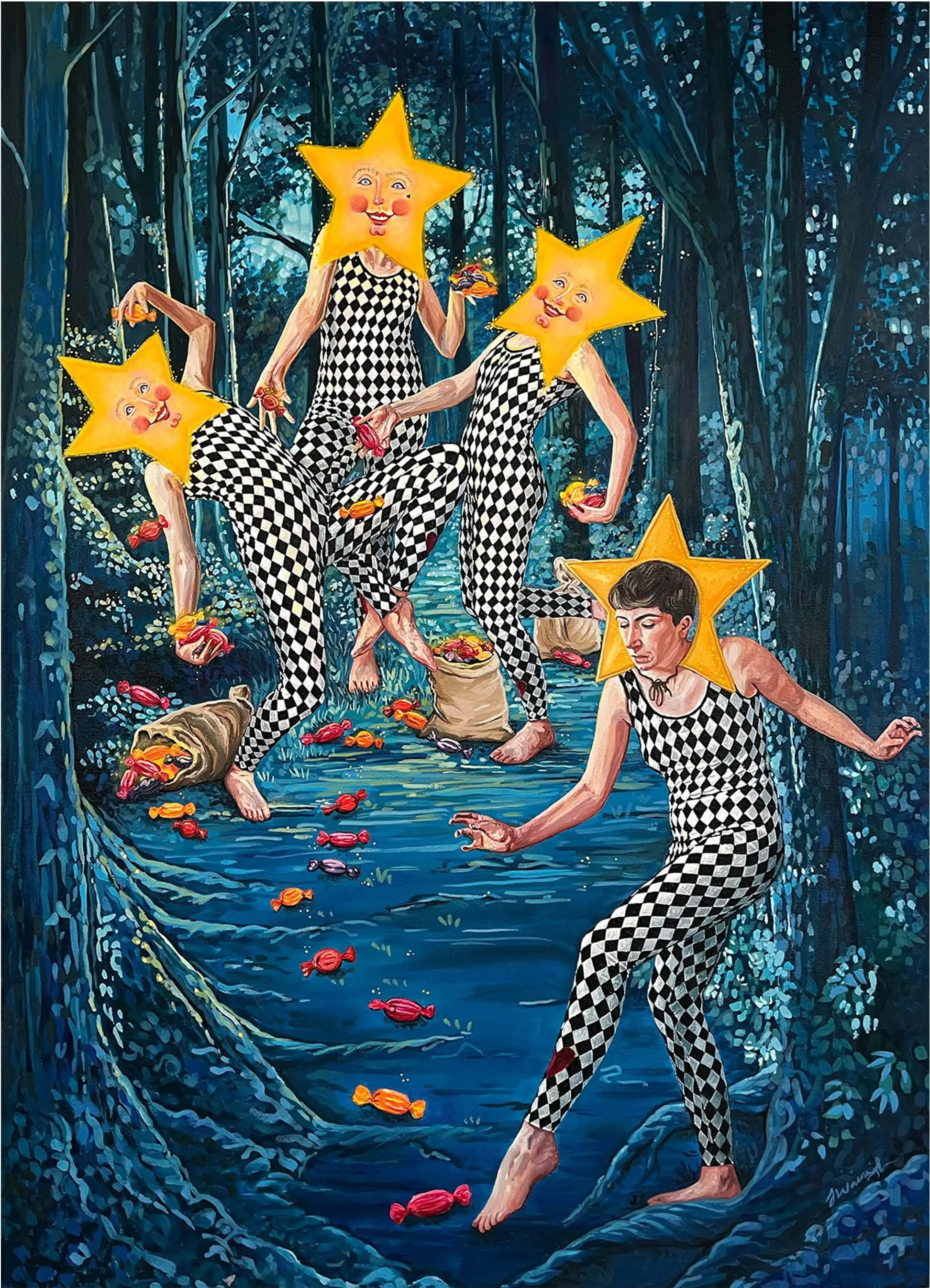
Jude Wainwright, Abandon!, Oil on canvas, 72x53cm, 2025
Blue grew out of an ongoing dialogue between artists Magdalena Gluszak-Holeksa and Michael Coppelov around colour, painting and the use of limited palettes. Blue occupies a significant place in both their practices, although they arrived at it through different processes. Through these conversations, a shared interest emerged in exploring how blue operates across contemporary painting and the different meanings it can hold.
Bringing together established and emerging UK-based artists whose work spans national and international contexts, the exhibition explores the varied ways blue is perceived, used and understood. Across practices engaging with abstraction, figuration, symbolism and process, blue becomes a shared thread connecting distinct artistic approaches, while revealing the different intentions, associations and possibilities that shape each artist's use of colour.
Rather than treating blue simply as a means of representation, Blue considers it as a condition that shapes perception. As Carol Mavor explores in Blue Mythologies, blue is neither singular nor fixed; it is sensed, remembered and continually reinterpreted. It can hold personal histories, evoke distance and familiarity, and suggest what remains beyond immediate visibility or expression. The exhibition invites viewers to consider not only what blue depicts, but what it makes possible: how a colour can shape the way we see, feel and understand an image, and how a shared visual language can open up different, sometimes contradictory, ways of experiencing.
Full Exhibition text and short essay here
We invite you to join us and experience how light, science, history, and contemporary art intersect across these three unique spaces.